From Smart to Genius: The Evolution of AI in Mobile Phones
Remember when “smart” phone meant a device that could browse the internet and send email? That was the ceiling. The phone did exactly what you told it — nothing more, nothing less. Today, mobile phones in Pakistan and across the world have leapt far beyond that premise. They predict. They translate. They compose. They edit your photos in ways that would have required a professional studio a decade ago.
This is not a minor upgrade. This is a fundamental redefinition of what a phone is. And it didn’t happen overnight. The journey from “smart” to “genius” unfolded in phases — each generation of chips, software, and ideas building on the last. Let’s walk through it.
The First Wave: Rule-Based “Intelligence”
The earliest AI features in smartphones were not AI in any meaningful sense — they were clever shortcuts. Auto-brightness adjusted your screen based on a sensor reading. Autocorrect applied a dictionary lookup. These systems followed fixed rules written by engineers. There was no learning, no adaptation, no surprise.
Even voice assistants in their first incarnations — Siri launched in 2011, Google Now in 2012 — were largely pattern-matching systems. They parsed keywords and returned scripted results. Ask them something slightly off-script and they’d fail completely, sometimes embarrassingly.
The phones were smart. The AI was not. Yet.
Voice Assistants & Keyword Matching
Siri and Google Now introduce the concept of talking to your phone. Responses are scripted, systems are rigid, but the idea takes root.
Machine Learning Enters the Camera
Google Photos introduces face grouping and scene recognition. Cameras begin understanding what they’re seeing, not just capturing pixels.
Dedicated AI Chips
Apple’s A11 Bionic (iPhone X) and Huawei’s Kirin 970 introduce NPUs — Neural Processing Units — built specifically to run AI workloads at speed.
Computational Photography & Real-Time AI
Night mode, portrait mode, and video stabilisation powered by neural networks. AI moves from a background feature to a headline selling point.
Generative AI Goes On-Device
Large language models shrink to fit inside a phone. Galaxy AI, Apple Intelligence, and Gemini Nano mark the beginning of a new era.
The Turning Point: Neural Processing Units
The real inflection came in 2017. Apple’s A11 Bionic chip — the brain behind the iPhone X — contained something new: a dedicated Neural Engine. This was silicon designed not for general computation, but specifically to run machine learning models. It could perform 600 billion operations per second. The face unlock on that phone wasn’t software trickery; it was AI running at hardware speed.
Other manufacturers followed fast. Qualcomm’s Snapdragon series, MediaTek’s Dimensity chips, and Samsung’s Exynos processors all built AI acceleration into their architectures. By 2020, virtually every mid-range and flagship phone had a dedicated AI engine. The hardware was ready. The question was: what would software makers do with it?
The Camera Revolution
If you want to see AI’s most visible impact on mobile phones, look at the camera. Modern smartphone cameras are less about optics and more about computation. The lens captures light. The AI decides what the photo should look like.
Night mode is the clearest example. When you shoot in low light, your phone doesn’t just brighten a dark image — it takes multiple exposures in rapid succession, identifies noise from signal, and blends a sharp, bright composite that your eye couldn’t have seen. This is machine learning running in real time, thousands of decisions per second.
Portrait mode goes further still. The phone must understand depth — which pixels belong to a person, which to the background. Then it applies a bokeh blur that a physical lens might produce. Older phones did this badly, blurring ears and stranding stray hairs. Modern phones, powered by models trained on millions of images, do it with uncanny accuracy.
For Pakistani users looking to explore smartphones with advanced camera AI, you can browse top camera phones under PKR 60,000 or, if you want the very best computational photography available, check out flagship-tier devices under PKR 100,000 on TechBazaar.
Galaxy AI, Apple Intelligence & the Generative Era
The most dramatic shift came with the arrival of generative AI on mobile — large language models compressed and optimised enough to run, at least partially, on a device you hold in your hand.
Samsung Galaxy AI
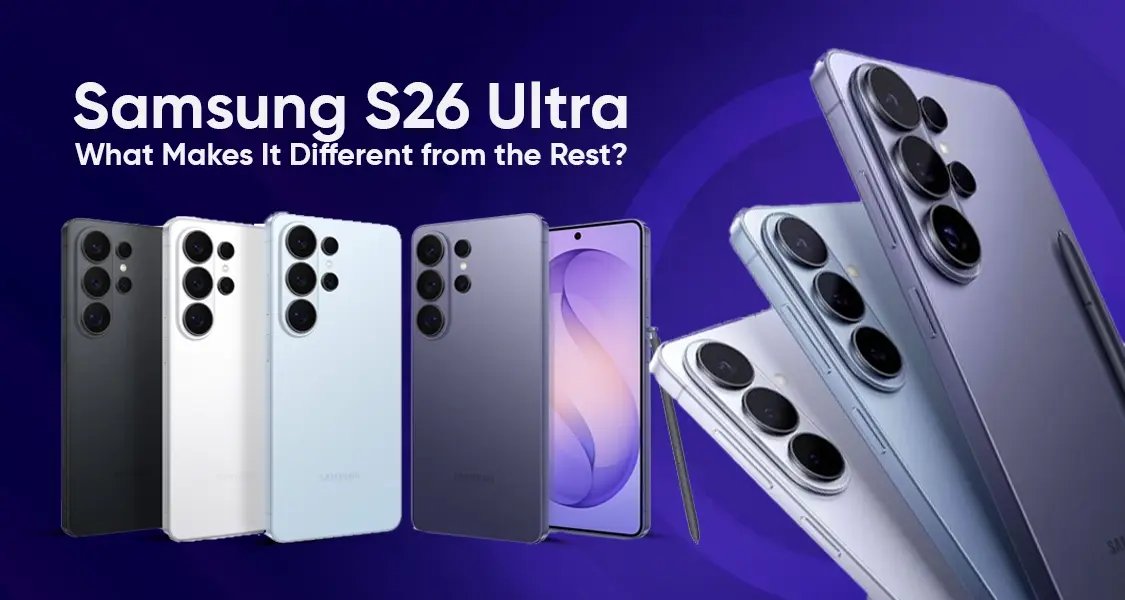
Samsung launched Galaxy AI with the Galaxy S24 series in January 2024. It was an industry moment. For the first time, a mainstream consumer phone offered features like Circle to Search (draw a circle around anything on screen to search it), Live Translate (real-time voice translation during phone calls), and Chat Assist (tone and language improvements for messages). These weren’t demos — they shipped in the box.
The Galaxy S26, revealed in February 2026, pushed further still with predictive tasking: the phone anticipates what you’ll do next and, in some cases, begins completing tasks on your behalf before you ask. If you’re a Samsung user or thinking of upgrading, explore the full range of Samsung mobile prices in Pakistan at TechBazaar.
Apple Intelligence
Apple’s approach has been characteristically privacy-first. Apple Intelligence — introduced with iOS 18 — keeps as much processing on-device as possible. Writing tools that rewrite, proofread, and summarise text. A smarter Siri that understands context across your apps, your calendar, and your habits. Image generation tools built into the Photos app. And crucially: the vast majority of this runs on your phone, not a server in another country.
What This Means for Pakistani Users
Pakistan’s tech market has never been better positioned to benefit from AI-powered phones. The multilingual reality of Pakistani life — switching between Urdu, English, regional languages, and often all three in a single conversation — is exactly the problem that AI translation and writing tools are built to solve.
For freelancers and small business owners, AI writing assistance means communicating more professionally in English even when thinking in Urdu. For students, AI summarisation tools condense hours of reading into digestible notes. For content creators, computational photography produces professional-quality images without expensive equipment.
The good news: you don’t need to spend a fortune. AI features have filtered down well below flagship pricing. Some of the most capable AI cameras and on-device intelligence now appear in phones well under PKR 50,000. Browse AI-capable phones under PKR 30,000, or explore the best smartphones under PKR 50,000 — you’ll find genuinely intelligent devices at accessible prices.
Ready to Upgrade to an AI Phone?
Whether you’re looking for a budget-friendly entry into AI photography or a top-of-the-line device with generative AI features, TechBazaar has the widest selection of smartphones available in Pakistan. Compare specs, prices, and features — all in one place.